Showing posts with label Invention. Show all posts

Tuesday, 1 March 2016

htc vive the virtual experience

The HTC Vive :

HTC-vive-2
Impressed with what you’ve seen so far from HTC’s VR headset? Then, good news – the outfit just announced the official consumer version of the HTC Vive, bringing a full set of innovative features that should break new ground for the modern generation of gamers.
Packaged as a complete kit, the headset comes with a pair of wireless controllers, a pair of base stations, a Vive Link Box, and a pair of ear buds, ensuring you have everything you need to immerse yourself in your favorite VR games and content. Just hook it up to a compatible gaming PC and you’re set.
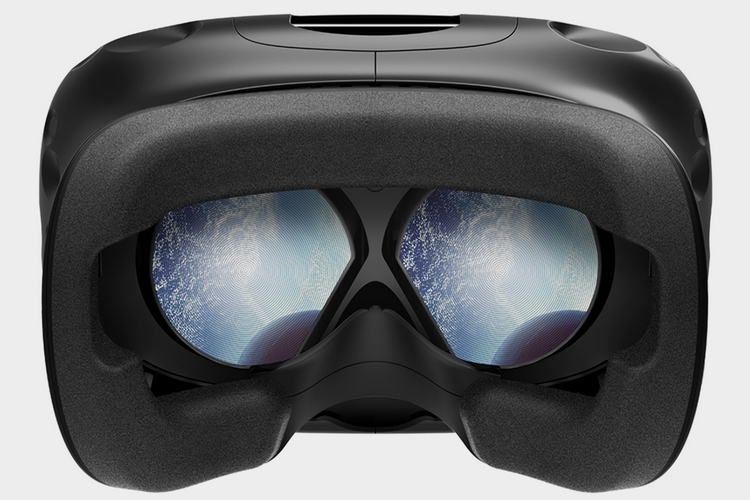
The HTC Vive comes with room-scale motion tracking, using 32 headset sensors to detect movement across a full 360 degrees, while a camera on the exterior allows it to blend real-world elements into the virtual experience. A 110-degree field of view allows for immersive visuals that are made even better by the 2,160 x 1,200 combined resolution and 90Hz refresh rate for seriously smooth-looking action. Interchangeable foam inserts and nose pads allow you to customize the fit to conform to the contours of your face, with enough room to accommodate your glasses, while an adjustable strap lets you cinch it for the most comfortable fit.
HTC-vive-3
While it won’t play smartphone-based VR content, it can pair with phones, allowing you to receive and respond to texts (pre-made messages only) and calls (it comes with an integrated mic), as well as get notifications. It’s powered by Steam VR. 
Slated to come out in April, the HTC Vive is priced at $799  (from coolthings.com)

PRE-ORDER YOUR VIVE TODAY at  http://www.htcvive.com/us/product/

Monday, 29 February 2016

hoverboard that rides not touching the ground

Hendo Hoverboard:


It’s not quite the hoverboard we wanted, but given the absolutely barren list of choices, the Hendo Hoverboard is the one we want anyway.  Yes, someone finally made a real hoverboard that can lift a short distance off the ground while supporting the weight of an adult on top.

Unlike the one Marty McFly rode in the Back to the Future movies, you can’t exactly take this one out for a spin around the neighborhood.  That’s because it can only hover on top of surfaces made from copper, so until the roads of your neighborhood are paved with the expensive metal, you’ll be confined to specialty studios rigged up specifically to ride it.


The Hendo Hoverboard doesn’t rely on air cushions to keep it suspended in mid-air the way existing hovercrafts do.  Instead, it relies on the same magnetic levitation (maglev) technology that high-speed levitating trains have been using to reduce friction during travel.  Four maglev engines sit directly under the deck, along with the battery pack, giving it that needed lift to float an inch above any ferromagnetic-conducting surface. On the reverse, it comes with a pair footpads to help the rider keep his feet from slipping while he maneuvers the board over a minimal amount of friction.


As of now, the board still appears to be in the early prototype stage.  It’s a semi-working prototype, though, which is amazing.  As in, it can hover about half an inch and ride frictionless, although it’s a bit impossible to maneuver at the moment (you’ll basically glide to wherever momentum takes you until you crash or puke or both).  So far, it’s an impressive proof of concept, although it might take a while before we actually get a consumer version.

Arx Pax, the company developing the Hendo Hoverboard, is currently running a Kickstarter campaign to help fund it.  Pledges to reserve one of the first 10 hoverboards they produce is set at $10,000.(from coolthings.com)


hover board that coming soon:


 know more about the hoverboard  http://hendohover.com 


charge wirelessly from distance

Wirelessly Charge Devices From 15 Feet Away:

While wireless charging has been with us in consumer form since the Powermat debuted in 2009, current evolution of the technology still sees us tethered to the charging pad. There are, however, a handful of efforts seeking to liberate us from this current predicament and the WattUp appears to be one of the most likely to find success.
Made by Energous, it’s a wireless charging system that uses a mix of Bluetooth, RF signals, and some patent-pending tech to enable sending power wirelessly to devices as far as 15 feet away. That way, you just have to be within the vicinity of the charging device (which, in this case, looks and functions like a bigger WiFi router) in order to get your phones, tablets, and similar gadgets juiced.
The WattUp can work with any battery-operated device that requires less than 10 watts to charge. While that probably rules any current generation of laptops, it should be enough for mobile phones, tablets, and other mobile gadgets. It uses a transmitter called the Power Router, which sends the energy via RF signal to a WattUp receiver pre-installed in the device, which then converts the signal into battery power. Up to 12 receivers can be managed by the Power Router simultaneously, continuously charging them even while the gadgets are in motion, provided they stay within range.
As of now, Energous is working on licensing their technology to other companies who can then integrate it into their own products. They’re releasing a reference design for both the transmitter and the receiver in around six months, which licensees can then use to pattern their own charging systems.


True Mobility

Wire-free power delivers on the promise of true mobility, the freedom to roam where you want to without worrying about your mobile or battery powered devices running out of charge.  While power cords and charging pads require you to surrender your device to a stationary location, WattUp® gives you the freedom to receive a charge from anywhere within a 30-foot end-to-end charging envelope.

Charges Any Battery-Operated Device That Requires Less Than 10 Watts:

WattUp RF-based charging can be integrated to provide wire-free charging to a wide variety of electronic devices such as cell phones, tablets, wearables, cameras, wireless keyboards and mice, headsets, sensors, LED lights, remote controls and toys; in essence any battery-powered device in your home or office.

Works Like Wi-Fi:

A WattUp transmitter, or Power Router, sends energy via a radio frequency (RF) signal to your WattUp-enabled electronic devices when requested. A WattUp receiver in each device converts that signal into battery power.
The entire system is software controlled, so it's intelligent and customizable to your needs and environment. And, because it's designed to work invisibly in the background, WattUp can make low battery anxiety a thing of the past.

How Does it Work?

A Radio Frequency (RF) system, similar to a Wi-Fi system, delivers safe wire-free charging energy at a distance of approximately 15ft from a transmitter to a receiver device, such as a mobile phone, and maintains charging while the receiver is in motion.  12 receiver devices can be managed by the system simultaneously.

The Hardware:

Highly targeted pockets of energy are delivered via multiple miniature antenna arrays and custom control chips in the transmitter, or Power Router.  Energy harvesting of the micro energy beams from these pockets then takes place via paired antenna arrays and custom chips in the receiver devices.(from coolthings.com)

The Software:

The WattUp® software system ensures that the charging waveforms are dynamically directed, focused and controlled via proprietary algorithms.  Charging and communication between transmitters and receivers is intelligently managed using BLE and enterprise-class wireless networking protocols.


Sunday, 28 February 2016

White laser


Scientists Create White Laser:


The future of home lighting could be lasers No, we don’t mean those headache-inducing laser light shows they use to give people even more stimulation in clubs and parties. Instead, we’re talking about lighting every place in your home, from the living room to the kitchen to the bedroom. Apparently, that’s possible now after a team of scientists recently discovered how to produce white laser.
In a study conducted at Arizona University, a team of researchers showed how a new breed of semiconductor lasers can emit light across the full visible spectrum, producing the full-range of colors necessary to generate white laser. The team used a thin layer of semiconductor with three parallel segments, each one emitting one of the three elementary colors. Depending on how their output is tuned, this layer can produce any color in the spectrum that, when combined, produces laser that is pristine white.
Lasers are brighter and more energy-efficient than the existing LED standard, apart from providing more accurate and vivid colors, making them an ideal candidate for the next-generation of lighting.  While this is merely a first step towards using lasers in that capacity, it’s a significant one.  Previous attempts at producing white laser used multiple hardware, whose light outputs were combined, whereas the Arizona University team’s white laser emanated from a single unit, making it more feasible for mainstream use. The researchers point out that their white laser technology can prove beneficial in many applications, including “solid-state lighting, full-color displays, visible color communications, and multi-color fluorescence sensing.
Creating White Laser:


   Monolithic semiconductor lasers capable of emitting over the full visible-colour spectrum have a wide range of important applications, such as solid-state lighting, full-colour displays, visible colour communications and multi-colour fluorescence sensing. The ultimate form of such a light source would be a monolithic white laser. However, realizing such a device has been challenging because of intrinsic difficulties in achieving epitaxial growth of the mismatched materials required for different colour emission. Here, we demonstrate a monolithic multi-segment semiconductor nanosheet based on a quaternary alloy of ZnCdSSe that simultaneously lases in the red, green and blue. This is made possible by a novel nanomaterial growth strategy that enables separate control of the composition, morphology and therefore bandgaps of the segments. Our nanolaser can be dynamically tuned to emit over the full visible-colour range, covering 70% more perceptible colours than the most commonly used illuminants(from coolthings.com)

samsung new 128GB RAM

New invention Samsung’s 128GB DDR4 RAM:

Samsung Starts Mass Producing Industry’s First 128-Gigabyte DDR4 Modules for Enterprise Servers

On the surface, this looks like a regular memory stick. Except, you know, there’s nothing regular about it, since that is Samsung’s upcoming 128GB DDR4 RAM chip. That’s right, there’s a whopping 128GB contained inside that slender frame.
Yes, we know, it’s overkill even for the most powerful gaming PCs. Then again, that’s not what Samsung is making these for. Instead, these are aimed squarely at data centers and enterprise servers, which can definitely use such an absurd amount of memory to accommodate the multitude of transactions they regularly handle.
Billed as a breakthrough not just in capacity but in energy efficiency, the Samsung 128GB DDR4 RAM ditches traditional wire bonding in favor of TSV circuitry, connecting the chip components using electrodes that pass through hundreds of fine holes. Each memory unit is composed of 144 DDR4 chips, arranged in 36 4GB packages, with a master chip on each one embedding the data buffer function, leading to optimized module performance and power consumption. It boasts twice the speed of existing memory systems, clocking in at 2,400 Mbps, while using 50 percent less power than any previous solution that offers this much memory.
No word on pricing, but the Samsung 128GB DDR3 RAM is now under production and likely to go on sale sometime next year.
Samsung Electronics:


Samsung Electronics announced that it is mass producing the industry’s first “through silicon via” (TSV) double data rate-4 (DDR4) memory in 128-gigabyte (GB) modules, for enterprise servers and data centers.

Following Samsung’s introduction of the world-first 3D TSV DDR4 DRAM (64GB) in 2014, the company’s new TSV registered dual inline memory module (RDIMM) marks another breakthrough that opens the door for ultra-high capacity memory at the enterprise level. Samsung’s new TSV DRAM module boasts the largest capacity and the highest energy efficiency of any DRAM modules today, while operating at high speed and demonstrating excellent reliability.

“We are pleased that volume production of our high speed, low-power 128GB TSV DRAM module will enable our global IT customers and partners to launch a new generation of enterprise solutions with dramatically improved efficiency and scalability for their investment,” said Joo Sun Choi, executive vice president, Memory Sales and Marketing, Samsung Electronics. “We will continue to expand our technical cooperation with global leaders in servers, consumer electronics and emerging markets, where consumers can benefit from innovative technology that enhances their productivity and the overall user experience.”

The 128GB TSV DDR4 RDIMM is comprised of a total of 144 DDR4 chips, arranged into 36 4GB DRAM packages, each containing four 20-nanometer (nm)-based 8-gigabit (Gb) chips assembled with cutting-edge TSV packaging technology.

Conventional chip packages interconnect die stacks using wire bonding, whereas in TSV packages, the chip dies are ground down to a few dozen micrometers, pierced with hundreds of fine holes and vertically connected by electrodes passing through the holes, allowing for a significant boost in signal transmission. In addition to capitalizing on the industry’s highest capacity and TSV’s advanced circuitry, Samsung’s 128GB TSV DDR4 module has a special design through which the master chip of each 4GB package embeds the data buffer function to optimize module performance and power consumption.

As a result, Samsung’s advanced 128GB TSV DDR4 RDIMM provides a low-power solution for next-generation servers with speeds at up to 2,400 megabits per second (Mbps), achieving nearly twice the performance, while cutting power usage by 50 percent, compared to using the previous highest capacity DRAM modules ─ 64GB LRDIMMs, whose four-chip package stacks are hampered by power and speed limitations caused by their use of conventional wire bonding.

Samsung is responding to growing demand for ultra-high capacity DRAM by accelerating production of TSV technology in the market and quickly ramping up 20nm 8Gb DRAM chips to improve manufacturing productivity. In solidifying its technology leadership and expanding the market for premium memory solutions, the company plans to provide a complete lineup of its new high-performance TSV DRAM modules within the next several weeks including 128GB load reduced DIMMs (LRDIMMs).

In addition, Samsung will continue to maintain its technology leadership by introducing TSV DRAM with higher performance. These will include modules with data transfer speeds of up to 2,667Mbps and 3,200Mbps that help to meet intensifying enterprise server needs, while expanding TSV applications into high bandwidth memory (HBM) and consumer products.( from coolthings.com)

Friday, 26 February 2016

Shoes that defy gravity


The Moon Walker:


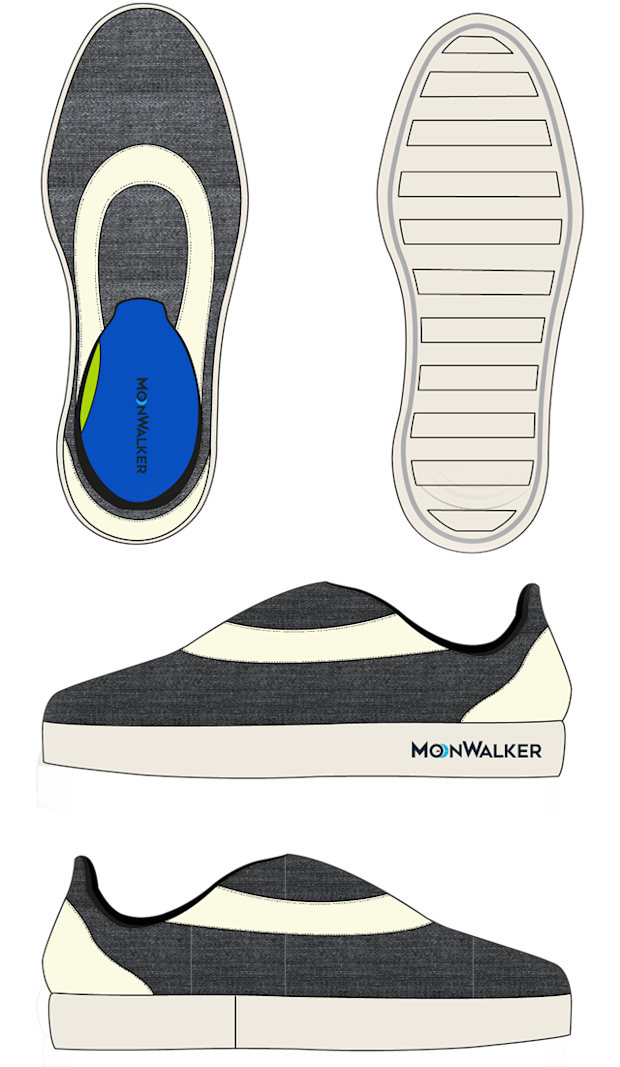
Introducing 20:16 MoonWalker, the gravity defying shoes with a modern and urban style. These unique shoes have two layers of strategically placed N45 magnets. The magnets are slim yet very powerful and face each other to create a repelling, anti-gravity force. The result is a lightweight walk that makes you feel like Neil Armstrong. The 20:16 MoonWalker shoes are ultra comfortable with their memory foam soles. With each step you can feel the foam contour to your feet. The interior is made with DuPont Tyvek synthetic polyethylene, the same material used by NASA. These shoes have no laces for easy on and off practicality yet they remain secure with a padded non-slip tongue. Experience the moon without leaving your town with the 20:16 MoonWalker gravity defying shoes.


When we dared to take those first few steps? 
We found ourselves standing there with only one way forward. Even though success was uncertain, we realized the world lay at our feet and, with that, lift off! 
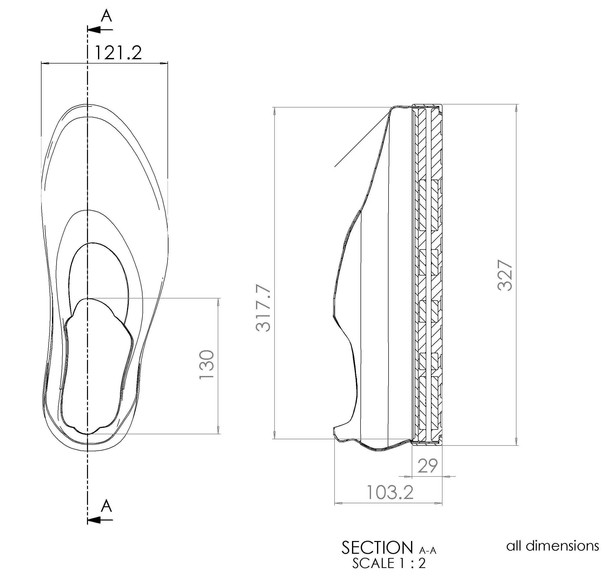
In the early days, one of our designs was Marta Pietrosanti's (who has her two own shoe brands and also worked for many major brands in sportswear and fashion like Ferrari , Masnada , Mountain Affair, and Studio Cocchi  technical drawings.
That was the biggest thing we had ever done—a new adventure where the sky was the limit. But then we grew up. Perhaps we feel like we have left that all behind. 
Until now…
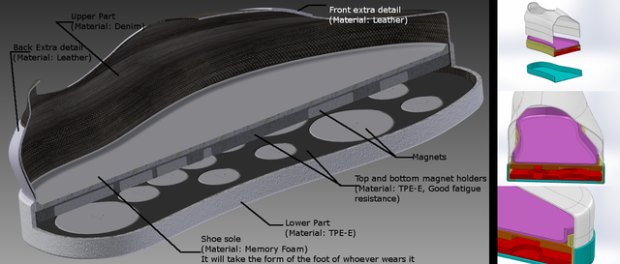
The moon-walking sensation comes from two layers within the shoe. Each layer is made up of powerful N45 magnets that are strategically placed so the north poles face each other. This creates a repellent force, which leaves you light on your feet and happy as an astronaut. 


The final touch is a comfy sole made from memory foam that hugs the unique shape of your foot, making it the perfect fit to moonwalk your way through life. 
How will MoonWalker bring back the exhilarating feelings you experienced as a child learning to walk for the first time? The secret lies in some pretty amazing technology.


Hidden beneath the incredibly durable yet soft and breathable fabric, under an inner sole of comfortable memory foam, rest two separate layers that hold something you definitely wouldn’t expect to find in a shoe.
Embedded inside are slim, ultra-powerful N45 Neodymium magnets. These magnets are generally used to lift anything from massive barbells to cars. Strategically positioned in the shoe, the magnets repel each other and push the layers apart. The result? A force field that keeps you suspended in space. Of course, a lot has gone into the research and development of this product.


We've done numerous CAD blueprints, prototype after prototype, tweaked and tested everything, including grip, magnetic power, breathability, durability, comfort, and street performance.
The outer layer is a smooth synthetic fabric in gray and white gradient featuring a padded, non-slip tongue. The inside is a DuPont Tyvek synthetic polyethylene, which is the same material used by NASA on their space station modules. 

pre book at : http://2016moonwalker.com/